
So yesterday, I was chatting with one of my friends – you know, the one with the “interesting” personality haha. We were talking about multilingual movies and how confusing it can get when characters randomly switch languages in the middle of a sentence.
That got me thinking—why do we do this?
I’m bilingual. Growing up in India, Hindi was my first language. It’s what I spoke at home, with friends, and basically everyone around me. But then school happened, and with it came English. Slowly, English became my second language, especially in academic and professional settings.
During our chat, my friend said something that made me laugh:
“I also find it odd that they just switch back and forth between English and Hindi.”
Lolol it was confusing. Unclear what prompted them to switch.
And that’s when it hit me—I have a theory. I’m sure there’s an official term for it, but here’s my unscientific (but hopefully relatable) explanation.
Thoughts Have No Language
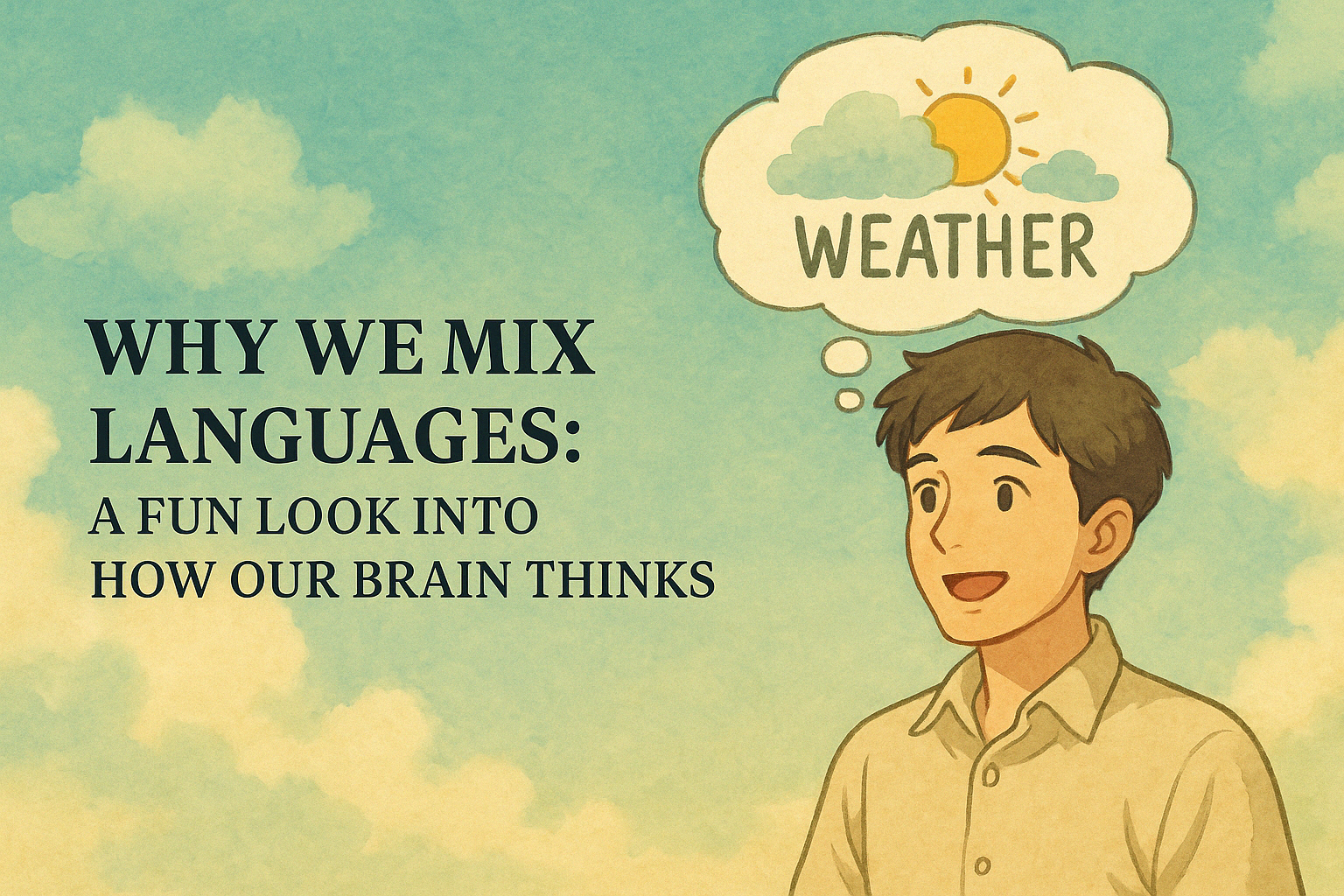
I think when we have a thought, it doesn’t begin in any particular language. It’s just an emotion, a feeling, or an image—kind of like those little cloud bubbles in cartoons. That’s Phase 1.
Then comes Phase 2—our brain kicks in and tries to convert that thought into words. And here’s where it gets interesting: every language we know starts competing to find the best words to express that thought.
If you’re multilingual, your brain is like a multi-threaded processor. Each language is a thread, working in parallel, racing to grab hold of the thought and put it into words.
For me, Hindi holds a heavier weight since I’ve spoken it for over 25 years. Let’s say my language load is 60% Hindi and 40% English. So when a thought wants to come out, the final sentence might reflect that balance.
For example:
“Kya mast weather hai aaj.”
(English: What a nice weather today!)
See what happened there? The thought came out in a perfect Hindi-English blend because that’s how my brain processed it.

How Our Surroundings Influence Language Choice
Our environment plays a huge role too. If I’m at work, where everyone speaks English, my brain gives English a higher weight—maybe 80% English and 20% Hindi. So naturally, I speak more English in that setting. But back home or with Indian friends, Hindi takes the lead again.
Why It’s Hard to Learn a New Language as an Adult
This also explains why learning a new language gets harder as we grow older.
When we’re young, no single language dominates our brain. Maybe we’re just 20% fluent in Hindi and English, so adding German or French is totally possible. It can even overtake the others if we practice it more.
But by the time we hit our late 20s, our main languages are well established. Trying to squeeze in a new language feels like trying to add a new track to a finished album—it just doesn’t flow.
I’ve tried learning a new language recently, and honestly, it was tough. I quit more times than I can count. My brain was like, “No room! Hindi and English are already doing a duet here!”
So What’s the Best Way to Learn a New Language?
Here’s where environment comes in again. If I really wanted to learn French, I think the most effective way would be to surround myself with French—books, music, movies, even conversations.
Or better—move to France. That immersion forces your brain to give more weight to the new language, because survival and communication depend on it.
And if I had a French girlfriend? Well, bonus points. That would definitely speed things up (and probably make it more fun too).
Final Thoughts
I really wonder how multilingual people manage all this. Do they have four or five threads running at once? Do their thoughts come out like:
“Aujourd’hui ka weather toh vraiment mast hai, no?”
Who knows! All I know is that our brains are doing some wild work behind the scenes.
So yeah—just another “interesting” conversation with my “interesting” friend, and a deep dive into how we think and speak!
What do you think? Do you switch between languages too? Ever wondered why? I’d love to hear your theory.

Leave a Reply